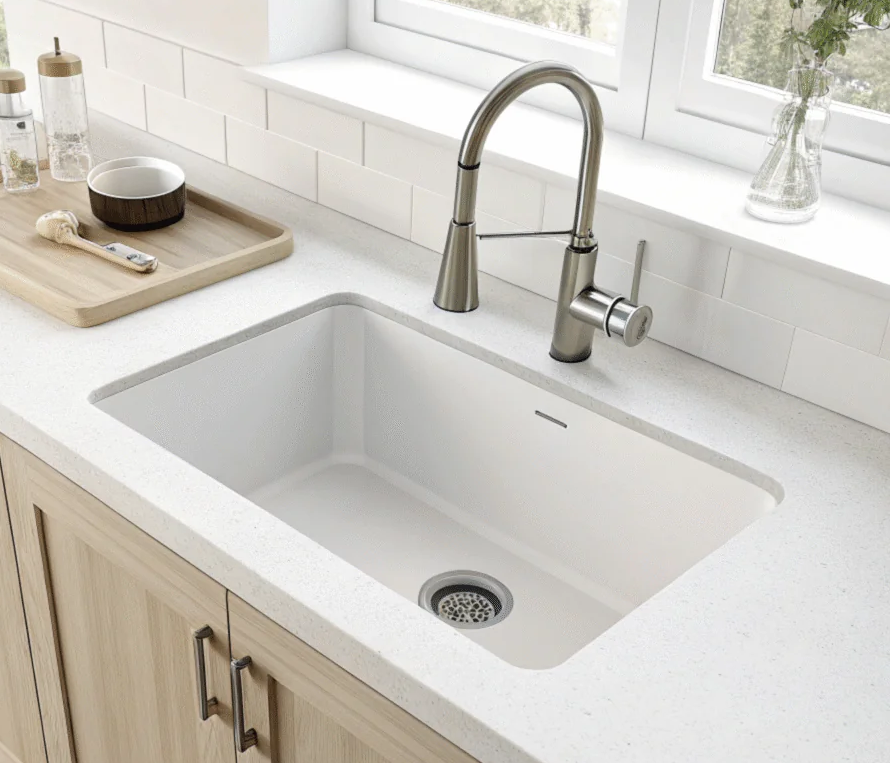

When homeowners and designers choose a kitchen sink, heat resistance is rarely the first feature that comes to mind — but it should be. Your sink handles boiling water every single day, and occasionally faces the brute force of a sizzling pan dropped straight from the stovetop.
Understanding how temperature and heat affect your granite composite sink helps you make smarter purchasing decisions, use your sink correctly, and protect your investment for the long haul.
What Is a Granite Composite Sink, Exactly?
Before diving into heat performance, it helps to understand what granite composite actually is. Unlike natural stone or stainless steel, granite composite is an engineered material — typically composed of 80% crushed quartz (granite) particles bound together with 20% acrylic resin. This specific ratio is not arbitrary. Higher mineral content translates directly to better heat resistance, scratch resistance, and long-term color stability.
At Chica Dragon, our granite composite sinks use a proprietary 80:20 quartz-to-resin formulation, manufactured through a High-Temperature Casting Forming Process. This production method compresses the material into a denser internal structure, which meaningfully improves the sink’s ability to handle both sustained heat and sudden temperature changes.

How Heat Affects Granite Composite Sinks
1. Sustained Heat: Where Granite Composite Excels
Granite composite sinks are purpose-built to handle the thermal demands of an active kitchen. The high concentration of natural stone particles gives the material excellent thermal stability under continuous heat exposure — the kind that comes from hot water running for extended periods, steam, or warm cookware resting briefly in the basin.
Most quality granite composite sinks are rated to withstand temperatures up to 200°C (approximately 535°F). Chica Dragon’s sinks meet this benchmark, making them more than capable of handling typical kitchen heat loads without warping, discoloring, or degrading in structural integrity.
Key heat-related benefits of granite composite include:
- Thermal mass:The density of stone particles slows heat transfer, so the sink absorbs and dissipates warmth gradually rather than spiking in temperature suddenly.
- Color stability:High-quality acrylic resins used in premium composite sinks resist UV and heat-induced fading, keeping your sink looking new over years of use.
- Non-porous surface: The dense, non-porous structure prevents moisture and heat from penetrating into the material body, reducing the risk of internal cracking over time.
2. Thermal Shock: The Risk You Need to Know
While granite composite handles sustained heat admirably, the more critical risk in a kitchen environment is thermal shock — the sudden, dramatic change in temperature that occurs when, for example, a pan is pulled directly from a 500°F oven and placed into a cool, damp sink.
Thermal shock causes rapid, uneven expansion and contraction within the material. Even though granite is far more heat-tolerant than plastic or porcelain, no composite material is entirely immune to this phenomenon. The acrylic resin component — which provides flexibility and binding strength — is the most vulnerable element. Under extreme thermal shock:
- The resin may soften or warp at localized contact points
- Micro-cracks can form at the surface layer over repeated incidents
- In severe cases, discoloration or surface marks may appear at the point of contact
The good news: thermal shock damage in quality granite composite sinks is largely preventable with proper use habits.
3. Cold Extremes and Temperature Cycling
Temperature stress doesn’t only come from heat. Repeated cycling between cold and hot — think running ice-cold water after a hot rinse — can stress the material over time. The stone-resin matrix handles this better than pure natural stone (which is more brittle and less elastic) because the resin component introduces a degree of flexibility. Still, avoiding extreme cycles unnecessarily extends the life of your sink.
Best Practices: Protecting Your Granite
Composite Sink from Heat Damage
Understanding the science is only useful if it informs how you use your sink. Here are the practical guidelines every bồn rửa tổng hợp đá granit owner should follow:
- Never place extremely hot cookware directly into the sink. Allow pots, pans, or baking sheets to cool for at least a few minutes before setting them in the basin.
- Run warm water first before pouring boiling water. This gradually raises the sink’s temperature and minimizes the shock of a sudden heat spike.
- Avoid placing dry, extremely hot items on the sink surface. A hot pan on a wet sink is slightly safer, but still not ideal — the water dissipates some heat before it concentrates on one spot.
- Use sink grids or protective mats. A bottom grid keeps cookware slightly elevated, preventing direct contact with the sink basin and providing an additional buffer against thermal transfer.
- Don’t leave boiling pots unattended in the sink. Prolonged contact with extreme heat — even within rated limits — puts unnecessary stress on the surface over time.

Manufacturing Quality Matters More Than You Think
Not all granite composite sinks are created equal when it comes to heat performance. The ratio of granite to resin, the quality of the resin formulation, and the manufacturing process all have measurable impacts on how a sink performs under thermal stress.
At Chica Dragon, our R&D team conducted 1,283 repeated tests to develop a proprietary formula that addresses the most common failure points in granite composite manufacturing: porosity, cracking, color inconsistency, and uneven material density. Our High-Temperature Casting Forming Process produces a denser internal structure that outperforms sinks made through conventional cold-molding methods.
The result: a sink that genuinely lives up to its heat-resistant claims — not just in laboratory conditions, but in the demanding reality of a busy kitchen.
Granite Composite vs. Other Materials
It’s worth putting granite composite’s thermal performance in context:
| Vật liệu | Heat Resistance | Thermal Shock Risk | Ghi chú |
|---|---|---|---|
| Đá granite tổng hợp | Up to 200°C / 535°F | Moderate | Resin component is the limiting factor |
| Thép không gỉ | Very High | Low | Conducts heat rapidly; can discolor at high temps |
| Fireclay / Ceramic | High (direct contact) | High | Brittle; prone to cracking from sudden changes |
| Cast Iron (enameled) | High | Moderate | Heavy; enamel can chip under impact |
Granite composite offers a strong balance — better aesthetic variety than stainless steel, better thermal shock resistance than fireclay, and superior scratch resistance compared to enameled cast iron.
Discover Chica Dragon Granite Composite Sinks
If you’re looking for a granite composite sink that delivers genuine, tested heat resistance without compromising on style, cô gái rồng is your trusted manufacturing partner. Since 2008, we’ve been crafting premium bồn rửa tổng hợp đá granite with an 80:20 quartz-to-resin ratio, using our proprietary High-Temperature Casting technology to produce sinks rated to 200°C. Available in 9 sophisticated colors — from classic matte black to elegant metallic-shimmer finishes — our sinks combine stone-solid durability with the design flexibility modern kitchens demand. Visit www.chicadragon.com to explore our full granite composite sink collection, request samples, or get a custom quote today.