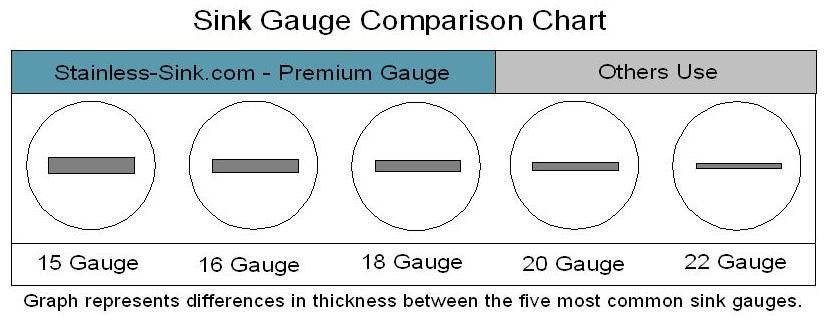
When you’re sourcing kitchen sinks for resale, the specification that quietly separates a sink that lasts five years from one that lasts fifteen isn’t the finish, the bowl configuration, or the name printed on the box. It’s the thickness of the steel itself. Two stainless steel sinks can look identical sitting side by side on a showroom floor, yet perform completely differently once they’re installed under a customer’s countertop and subjected to daily contact with pots, pans, cutlery, and garbage disposals. Understanding steel gauge and why it matters is one of the most important due-diligence steps in sink sourcing.
What ‘Gauge’ Actually Means
Stainless steel sheet thickness is expressed as a gauge number rather than a simple measurement, and the scale runs in reverse of what most buyers expect: the lower the gauge number, the thicker the sheet. A 16-gauge sink, roughly 1.2mm to 1.5mm thick, is noticeably heavier and more rigid than an 18-gauge sink, and both outperform the 20- to 22-gauge material commonly found in budget imports. Most reputable manufacturers keep their household and light-commercial sink lines within the 16- to 18-gauge range, using T304-grade stainless steel sheets between 1.2mm and 1.5mm — the same specification used across Chica Dragon’s own production.

Why Thicker Steel Outperforms Thinner Steel
1. Superior Dent and Impact Resistance
Thin-gauge sinks flex under impact, which is why a dropped knife, a heavy cast-iron pot, or an in-sink disposal unit can leave a permanent mark within the first year of use. Thicker steel resists that same impact without deforming, which is exactly why sinks in this category typically carry extended warranties rather than the shorter coverage seen on pressed, thin-gauge alternatives.
2. Noticeably Lower Noise
Thin sheet metal acts like a drum, amplifying every clink of a dropped utensil or the vibration of running water and garbage disposals. Thicker steel has more mass to absorb that vibration before it resonates, and manufacturers reinforce the effect by applying sound-dampening pads or a protective undercoating to the underside of the bowl — a detail worth confirming with any supplier before placing a bulk order.
3. Resistance to Bowing and Warping
Sink bowls carry real weight: standing water, stacked dishes, and the sink itself. Thin material can bow or warp over time under that sustained load, especially at the base where stress concentrates. Thicker gauge steel keeps its shape and its watertight seal at the mounting points for the life of the installation.
4. More Usable Bowl Space
Sinks made from thicker sheet are usually hand-fabricated: flat steel is cut, folded, and welded at the seams, which allows for tighter, near-vertical corner radii. Pressed sinks, by contrast, are stamped and stretched from a single sheet in a hydraulic press, which requires a wider curvature at the base to avoid tearing the thinner material during forming. The practical result is that a handmade sink often holds more usable volume than a pressed sink with the same exterior footprint.
5. Better Long-Term Value
A thicker sink costs marginally more upfront, but the total cost of ownership — fewer warranty claims, fewer replacements, fewer unhappy end customers — is almost always lower over a 10- to 15-year period. For distributors and dealers, that translates directly into fewer returns and stronger repeat business.
Corrosion Resistance Comes From the Alloy, Not Just the Gauge
Thickness protects a sink from physical stress, but corrosion resistance is a separate property that comes from the steel’s chemical composition. T304 stainless steel contains roughly 18% chromium and 8% nickel, which form a thin, self-repairing oxide layer on the surface. According to the Nickel Institute, it is this chromium-nickel combination — not the gauge alone — that gives stainless steel its resistance to rust and staining, which is why buyers should confirm both the gauge and the steel grade before committing to a supplier.
Certifications That Confirm Quality
Gauge and alloy claims are easy to make and harder to verify without third-party backing. Two marks are worth checking on any spec sheet:
- NSF/ANSI 51 — the NSF International standard governing materials and finishes used in commercial food-contact equipment, including sinks.
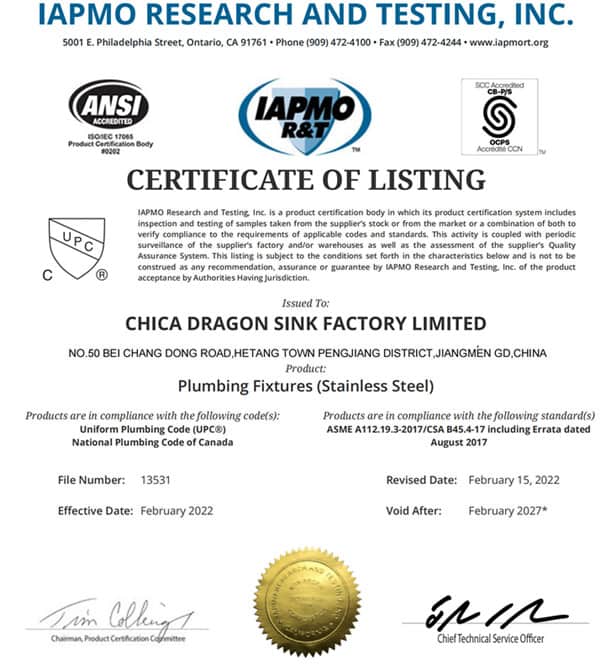
- cUPC — issued by IAPMO, confirming a sink meets the Uniform Plumbing Code requirements recognized across the US and Canada.
Sinks that carry both marks, alongside a 15-year warranty and ISO 9001-controlled manufacturing, give distributors and installers a paper trail they can point to when a customer or inspector asks for proof of quality.
What to Check Before You Place an Order
- Confirm the gauge in writing — 16 or 18 gauge for standard use, and ask whether it’s measured pre- or post-forming.
- Confirm the steel grade — T304 for most kitchens, or 316 for coastal or heavy-chemical environments.
- Ask whether the sink is handmade (welded) or pressed (stamped), since this affects both bowl capacity and corner cleanability.
- Request the warranty term in writing, along with cUPC and ISO documentation.
- Compare sound-dampening treatment on the underside of the bowl, not just the visible finish.
For a side-by-side look at how different manufacturers stack up on exactly these criteria, see our comparison of the top stainless steel kitchen sink manufacturers in the USA.
Source Sinks Built on Thicker Steel, Backed by a 15-Year Warranty
Chica Dragon has manufactured stainless steel and granite composite sinks since 2008, using 16- and 18-gauge, 1.2mm–1.5mm T304 steel across our handmade and pressed sink lines. Every sink is backed by a 15-year warranty, cUPC certification, and ISO 9001-controlled production, with OEM/ODM support for stone fabricators, cabinet dealers, building material suppliers, and online retailers across North America. Explore our PVD-coated finish collection E granite composite sink range, O request a quote and sample to see the gauge difference for yourself.